
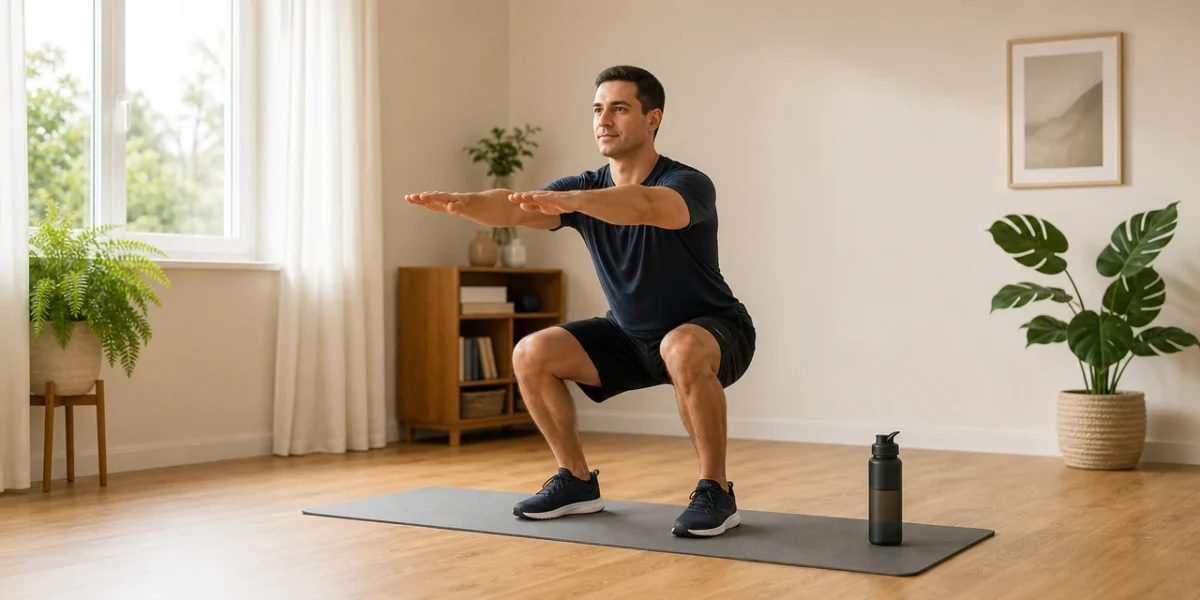
Home Exercises: Safe Guide for Beginners
Home exercises can help you get out of sedentary lifestyle without gym, expensive appliances or a lot of space. The best start is simple: choose basic moves, make short sessions, heat up before and gradually increase effort. For most adults, a consistent routine is more important than long and exhaustive training in the first week.
This guide shows how to organize a home workout, what exercises to use, how to control intensity and when to seek professional guidance. The World Health Organization Recommendations encourage adults to accumulate aerobic activity throughout the week and include muscle strengthening regularly. Those who are still, however, can start with less and gradually evolve.
Why start with exercises at home?
The domestic environment reduces barriers such as displacement, tuition and lack of time. You can train before work, during a break or in a short session at the end of the day. It is also possible to adapt almost all movements to their current level.
In addition to contributing to conditioning, strength and mobility, regular physical activity can favor sleep, reduce momentary anxiety and support cardiovascular health. Even small amounts are already better than remaining completely inactive.
The initial target does not need to be reached immediately the full weekly recommendation. First, make the habit of showing up for practice. Then increase the duration, frequency or intensity, but not all at the same time.
How to prepare a small space for training?
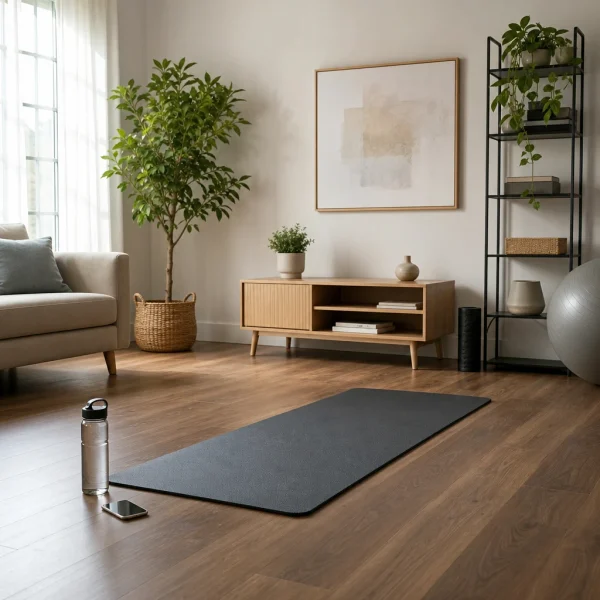
You need enough area to extend your arms, take a few steps and lie down on the floor without hitting furniture. Before you start, remove loose objects, remove carpets that slip and make sure the floor is dry.
Wear clothes that allow movement and footwear suitable for the type of exercise. For floor activities, a stable carpet can improve comfort. For heels or rope, confirm that there is room around and if the floor does not increase the risk of slipping.
A quick preparation avoids improvisation:
- leave water nearby;
- Keep your phone out of the way;
- choose a playlist or timer before starting;
- set a place to store the accessories.
Which exercises at home are best for beginners?
Start with movements that allow you to control posture and adjust amplitude. It is not necessary to do many repetitions. The priority is to learn the movement pattern and finish the session feeling that it would still be possible to do a little more.
| Objective | Initial year | Simple adaptation | Suggestion of start |
|---|---|---|---|
| Heat | Stop march | Reduce speed | 2 to 3 minutes |
| Legs | Stitching in the chair | Use support | 2 series from 6 to 10 |
| Breast and arms | Flexion on the wall | Close your feet. | 2 series from 6 to 10 |
| Trunk | Gluteal bridge | Do less repetitions | 2 series from 8 to 12 |
| Mobility | Shoulder and hip circles | Decrease amplitude | 30 seconds |
| Light cardio | Side steps | Don't jump | 3 blocks of 30 seconds |
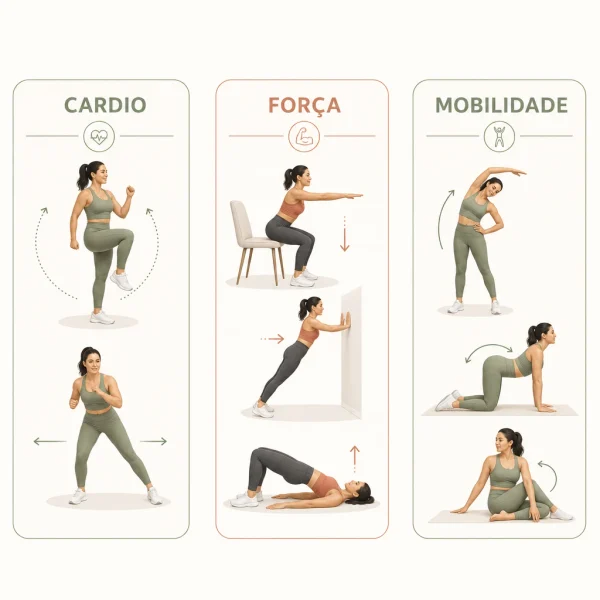
A basic session may have standing motion, squatting on the chair, bending on the wall, gluteal bridge and lateral steps. Rest between the exercises and stop before losing control of the technique.
Like setting up a practice routine at home?
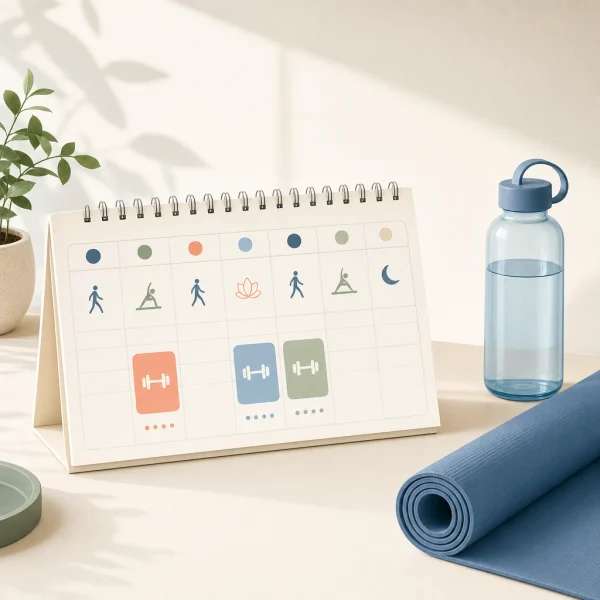
A good fitness routine needs to fit into your real life. For the first week, try three sessions of 15 to 20 minutes, interspersed for lighter days. On the other days, include short walks, mobility, or active household chores.
Example of week to get out of sedentary lifestyle
- * *Monday:** Light force, with squatting, bending on the wall and gluteal bridge.
- * *Wednesday:** Low-impact cardio, with standstill and lateral steps.
- * *Friday:** Repeat the light force, observing if the technique improved.
- Third, Thursday and Saturday: Comfortable walk or mobility for a few minutes.
- Sunday:rest or pleasurable activity without performance obligation.
The duration may increase every five minutes when the previous session seems controlled. The CDC Guidelines for adults recommend choosing activities compatible with your skills and gradually increase the volume.
To fit training into realistic schedules, read [Rotine Organization for More Productivity](/routine-for-more-productivity/ organisation). It is also worth knowing [How to Build a Healthy Routine: Guide to a Sustainable and Balanced Life](/how to build-a-routine-healthy-guide-to-a-life-sustainable-and-balanced/). Training tends to last longer when it is associated with a time, a trigger and a simple action, such as changing clothes when you get home from work.
How to control the intensity without braces?
Use the speech test. In moderate intensity, you can speak short sentences, but realize that you are breathing faster. If you can only say a few words, the effort is probably high for an early stage.
Another strategy is to use a scale from zero to ten. Start between three and five, in a comfortable to moderate perception. Exercises at home need not end in exhaustion, tremors or nausea to be useful.
Note also the recovery. If you take too long to catch your breath, feel dizzy or notice an important fall in coordination, slow down and rest. Evolution should improve your ability to train, not turn each session into a resistance test.
Heating and safety: what to do before?
Do five to ten minutes of light movements, such as standing still, shoulder mobility, alternating knee elevation and gentle knee push-ups. The NHS Heating Guide directs prepare the body before more demanding exercises and stop immediately if there is pain or malaise.
Avoid cold aggressive stretching, uncontrolled rapid movements and abrupt volume increases. If you have heart disease, diabetes, injury, persistent symptoms, are pregnant, have recently undergone surgery or intend to start vigorous activity after a long time, seek guidance from a health professional.
Stop training and seek help if chest pain, fainting, intense breathlessness, confusion, sudden weakness or acute pain does not improve. Security comes before the weekly goal.
Equipment really needed
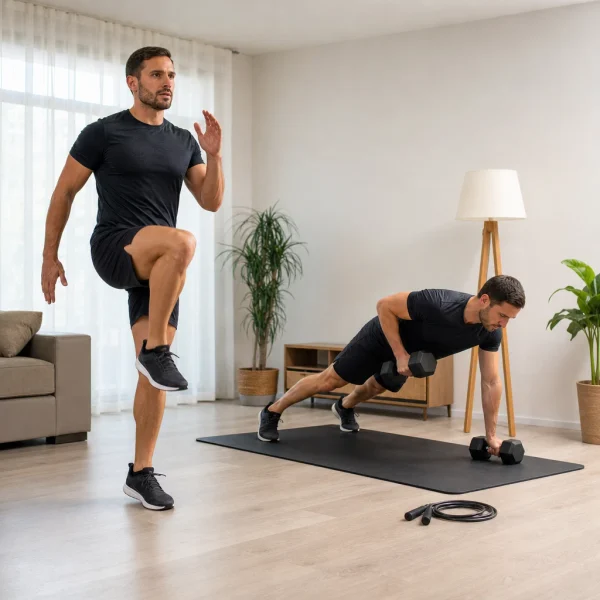
Body weight is enough to begin with. A carpet can facilitate floor exercises, while a firm chair provides support for adapted squats. The jump rope is optional and should enter after you master less impact exercises.
To train with more comfort in different exercises, the Anti-slip Tape for Exercises, Pilates and Yoga helps create a stable surface for your home routine. Check out Carpet Non-slip for Exercises, Pilates and Yoga to know the details and decide if this option matches the next recommended step in this content.
If you already master the basic movements and want to include short cardio stimuli, the [Jumping Cord](/ jump rope/) can complement home training, provided it is used progressively and in a safe space. Check Jump Rope for details and decide if this option matches the next recommended step in this content.
For those who prefer to follow a specific orientation on conditioning, the content Cardio Fitness can be considered as a complementary resource to the routine, without replacing professional evaluation when necessary. Check out Cardio Fitness for details and decide if this option matches the next recommended step in this content.
To deepen the foundations of the movement, read [Regular Physical Exercise, the Fundamental Pillar of Health](/Regular-o-pillar-fundamental-of-Saude/ exercise). In days without structured training, Diary Walk: Transform Your Physical and Mental Health A Step by Time can help keep the body active.
FAQs about exercises at home
Can I start exercises at home even though I'm sedentary?
Yeah. Start with short sessions, low impact movements and comfortable intensity. Gradually increase as your tolerance and interrupt if acute pain or malaise arises.
How many minutes should I train?
Between 15 and 20 minutes is already a practical start for many people. The objective is to build consistency and then progressively approach the weekly recommendations.
Do I have to practice every day?
Nope. Three weekly sessions are enough to create an initial basis. On other days, light walks or mobility can keep the body active without requiring complete training.
Home exercises help you lose weight?
They may contribute to energy expenditure and health, but the result depends on the set of physical activity, diet, sleep, health conditions and time. Avoid quick promises and also accompany willingness, strength, and regularity.
Is it normal to feel pain after practice?
Mild muscle fatigue can happen, especially when you resume movement. Acute pain, severe swelling or persistent worsening require pause and professional evaluation.
When can I start jumping rope?
Start when you have control of movements, safe space and good tolerance to low impact exercises. Make brief intervals, prioritize soft landings and do not seek maximum speed at the beginning.
What to do now
Choose three days this week, book 15 minutes and have a warm-up session, three strength exercises and a short block of light cardio. Record only presence, duration and how you felt. This follow-up shows evolution without relying exclusively on weight or appearance.
After two weeks, increase only one variable: a few more minutes, an additional series or a slightly higher rhythm. Combine home exercises with Daily Walk: Transform Your Physical and Mental Health A Step by Time, proper sleep and simple habits that transform well-being. The best training is the one you can safely repeat.
Comments
Loading comments…