
Healthy relationships: how to rebuild two
* *Healthy relationships ** are not relations without conflict. These are bonds in which there is security, respect, autonomy, dialogue and willingness to repair damage. If the couple are in crisis, the first step is to interrupt insults, threats and decisions made at the height of anger. Next, it is necessary to identify the pattern of discussion, transform complaints into concrete requests and evaluate professional help when attempts to change do not work.
Not every crisis means the relationship is over. Discussions about money, tasks, children, intimacy or family can hide loneliness, burden and loss of trust. However, love does not make humiliation, control, coercion or violence acceptable. This guide presents a practical way to recognize problems, improve communication, establish agreements and choose couples therapy. The guidelines are educational and do not replace psychological, medical, legal or emergency care assessment.
What characterizes healthy relationships?
Essential signs in everyday life
A healthy relationship allows closeness without requiring partners to abandon identity, friendships, privacy or personal projects. The decisions that affect the couple are discussed, and each person can express discomfort without fear of punishment.
The most important signs are:
- * *Respect:** there is no humiliation, intimidation, contempt or attacks on dignity.
- * *Security:** Nobody fears physical, sexual, emotional or patrimonial aggression.
- * *Reciprocity:** affection, responsibilities and decisions do not always fall on a person.
- Autonomy: Each partner maintains legitimate interests, ties and individual choices.
- * * Clear limits:** to say “no” does not cause blackmail, threat or punitive silence.
- * *Trust:** agreements are met or renegotiated with transparency.
- * *Repair:** Whoever misses recognizes the impact, apologizes and changes behavior.
Inhealthy relationships, disagreeing is not the same as disrespecting. The couple can have different opinions and still talk without turning the other into an enemy. The alert appears when destructive behaviors are repeated and there is no real responsibility for the suffering caused.
Why does the couple always repeat the same fight?
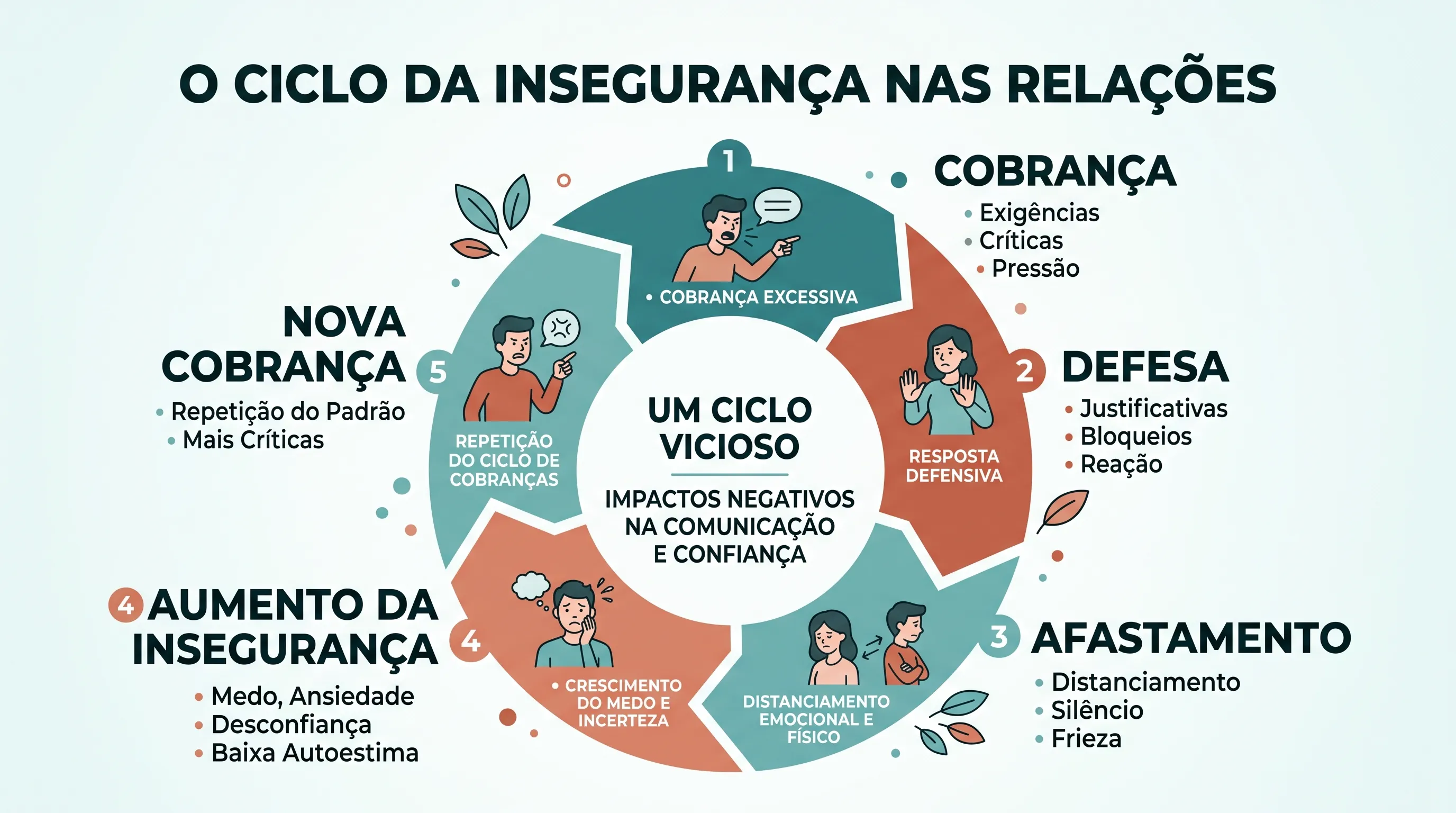
Map the cycle, not just the subject
Many couples discuss the most recent event, but do not realize the emotional need behind it. A fight over dishes could represent overload. A discussion of unanswered messages may reveal fear of abandonment. A financial conflict may involve insecurity, different priorities or lack of participation in decisions.
A frequent cycle happens like this:
- A person charges attention, recognition or change.
- The other interprets the charge as an attack and defends itself or departs.
- Distancing increases the insecurity of those who started the conversation.
- The collection becomes more intense and generalizations or accusations arise.
- Both end up hurt, while the original problem remains unsolved.
Identifying the cycle does not mean stating that all attitudes have the same weight. Each person remains responsible for their choices, especially when there is threat or aggression. The purpose is to realize at which moment a different response can interrupt the pattern.
Instead of saying “you never care about me”, try: “When we spend several days without talking calmly, I feel distant. Can we separate 20 minutes after dinner?” The second sentence presents a situation, a feeling and an observable request.
How to Improve Relationship Communication?
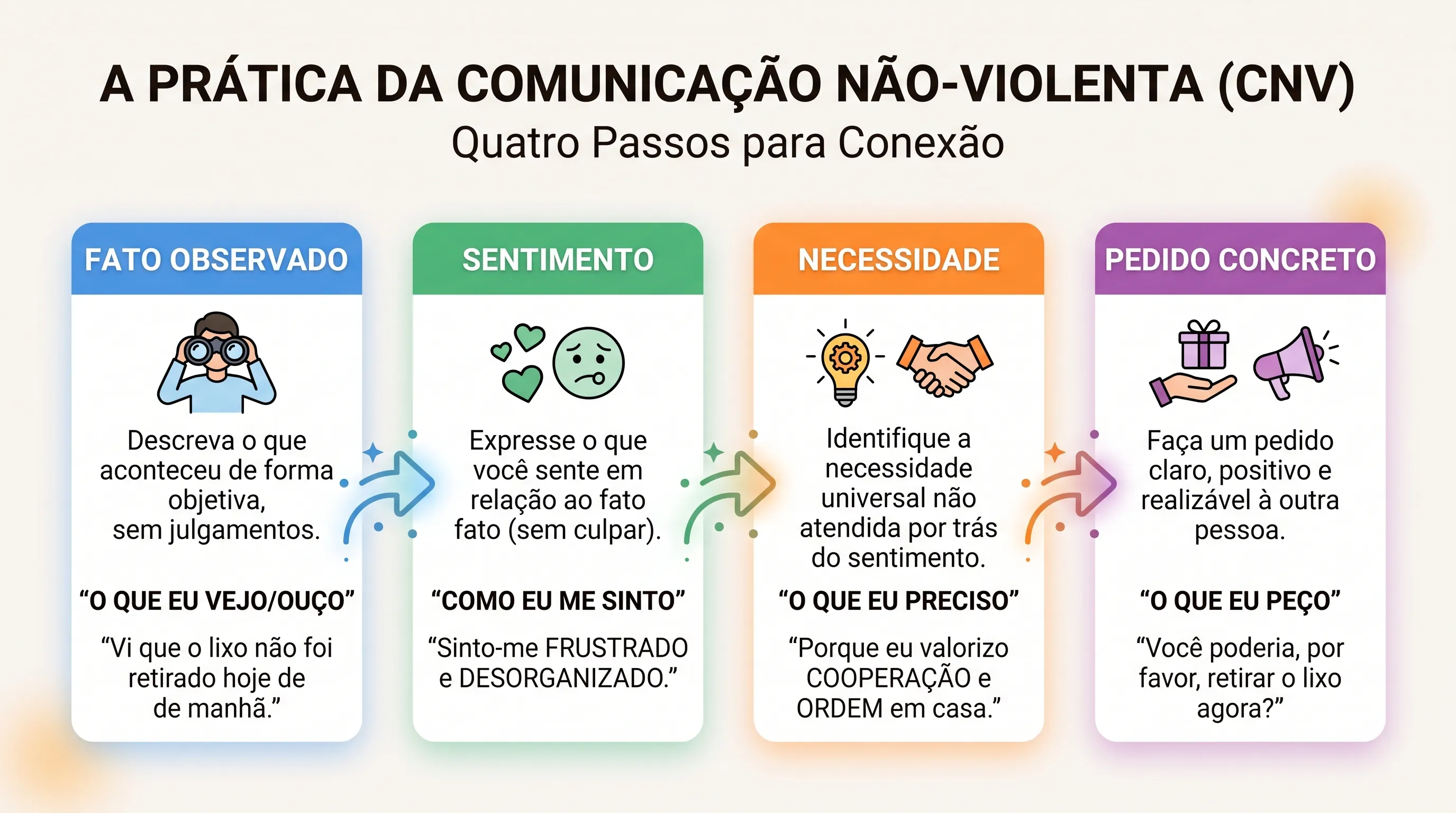
Prepare the conversation before you begin
Do not try to resolve a crisis when someone is drunk, driving, going to work, too tired or taken by anger. Postponing can be responsible, as long as there is a time to resume: “I need to calm down; can we talk at 7pm?”.
Pick one problem at a time. Bringing years of sorrow to a single discussion increases defensiveness and makes any agreement difficult. Define a specific theme, such as division of tasks, expenses, privacy, intimacy or family life.
Talk about facts, feelings and requests
A simple structure helps reduce charges:
“ When it happens , I feel . I need . Can we combine ?”
A useful request describes a possible action, such as “avise when you are late”. Expressions such as “mude of personality” or “be a better person” are vague and do not allow to follow the result.
Before you hit, repeat with your words what you understood. Understanding does not mean agreeing; it means demonstrating that the message was received. If there are screams, take a break with combined duration. The pause should regain self-control, not punish the partner with disappearance or prolonged silence.
Plan to rebuild healthy relationships
Turn promises into observable agreements
Saying “everything will be different” has little value if the promise does not appear in routine. Forhealthy relationships to develop, agreements need to be specific, possible, accepted by both and revised after a deadline.
| Area in crisis | Unusual agreement | Clear and observable agreement | Monitoring |
|---|---|---|---|
| Communication | “ Let’s stop fighting” | Do not use swearing and pause for 30 minutes if there are screams | Weekly Talk |
| Time to two | “ Let’s get closer” | Book an hour without screens every Wednesday | Shared Agenda |
| Tasks | “You need to help” | Set responsible for kitchen, clothes and shopping | Visible frame |
| Finance | “ Let’s spend less” | Set limit for purchases without consultation | Monthly revision |
| Trust | “You need to trust” | Compliance with the agreement created after the breach of trust | Periodic check-in |
| Intimacy | “We need to get back to normal” | Talk about affection, desire, consent and discomforts without pressure | Private chat |
Choose one or two changes initially. Trying to reform the whole relationship at the same time can lead to frustration and prevent the couple from noticing small advances.
For four weeks, book 20 to 30 minutes a week to evaluate what brought the couple together, what caused suffering and what concrete attitude each person will take until the next meeting. If the conversation ends repeatedly in attacks, fear, threats or punitive removal, seek professional evaluation.
When are you looking for couples therapy?
Situations justifying professional help
Therapy can supporthealthy relationships before the crisis becomes unsustainable. Repeated discussions, emotional distancing, difficulty in regaining confidence and inability to make important decisions are legitimate reasons to seek care.
A meta-analysis published in 2020 gathered 58 studies, representing 2,092 couples, and found relevant effects of couples therapy on satisfaction with the relationship, communication, emotional intimacy and behavior between partners. The study itself has limitations, including sample composition. These results do not guarantee that all relationships will be preserved, but indicate that professional interventions can produce important benefits.
The search for therapy deserves consideration when the same discussion is repeated without solution; there is suffering after lying or infidelity; affective or sexual distancing persists; conflicts about children, money or family members dominate the routine; or the couple cannot talk without verbal aggressions.
Therapy shouldn't work as a court of law. The psychologist helps to understand patterns, organize conversations, set goals and develop different responses. The process can also help the couple recognize limits and decide more clearly between reconstruction and separation.
How to choose a psychologist for couples therapy?

What to ask before starting
In Brazil, the psychologist must have active professional registration. The consultation can be made in the National Register of Psychology Professionals. In addition to the record, ask about training, experience with couples and familiarity with the type of problem presented.
In the initial conversation, try to clarify:
- What is the experience of the professional with couples therapy?
- How will treatment objectives be defined and evaluated?
- Will there be individual interviews and joint sessions?
- How does confidentiality about information disclosed individually work?
- How are situations of violence, coercion or fear evaluated?
- What are the rules of frequency, fees, cancellation and online service?
Some discomfort is expected when painful themes are addressed. However, no one should be humiliated, pressured to remain in the relationship or treated with prejudice. If the method is unclear or there is no trust in the professional, talk about the difficulty and consider a second evaluation.
If only one person wants to participate, individual therapy can still help. It allows understanding limits, reducing impulsive reactions and deciding what is possible to accept. A person can modify his participation in the cycle of conflict, but can't build respect and reciprocity alone.
When the priority isn't saving the relationship?
Recognize violence, coercion and immediate risk
If there is fear, physical aggression, sexual violence, persecution, threat, financial control, isolation, destruction of objects or constant surveillance, the priority is security. In such circumstances, an improvised conversation or a joint session may increase the exposure of the victim and should not replace specialized evaluation.
Do not confront the aggressor alone if it can raise the risk. Look for a health service, social assistance, public security or legal advice. Women can search for free the Call 180, which works 24 hours a day for guidance and referral of complaints. In an emergency, call the military police for 911.
Men and people of any identity may also suffer violence by partners and should seek the local health network, assistance, security or legal support. Protection does not depend on the couple deciding at that time whether they will continue together.
If the crisis is accompanied by thoughts of suicide or risk of self-aggression, look for a UPA, emergency room, CAPS or SAMU by 192. CVV offers free emotional support for 188. In immediate danger, do not leave the person alone and seek emergency care.
Frequently asked questions about healthy relationships
Is it normal to argue in healthy relationships?
Yeah. Disagreements are part of living together. The main point is to argue without fear, humiliation, threat or aggression and to achieve repairs or agreements.
How do you know it's still worth a try?
Observe whether there is security, respect, responsibility for the errors and consistent effort of both. Promises without change and repetition of violence require prioritizing limits and protection.
How long does it take to regain confidence?
There is no universal deadline. Recovery depends on the severity of the breach, transparency, respect for limits and the repetition of reliable behaviors.
Does couples therapy prevent separation?
There's no guarantee. The process can improve communication and intimacy, but also help the couple to conclude that a respectful separation is the most appropriate decision.
Can online service be used by couples?
It can, when the psychologist considers the appropriate modality and both have privacy and technical conditions. Confirm professional registration and talk about confidentiality and security.
Should we tell the kids about the crisis?
Children do not need to know intimate details or choose sides. Explain only what is necessary, reaffirm that they did not cause the conflict and preserve their routine and security.
Conclusion
Healthy relationships are built by repeated attitudes, and not just by statements made after a fight. Recognizing the cycle of conflict, making clear requests, complying with agreements and respecting limits are steps that help the couple assess whether there is real space for reconstruction.
Start by choosing a specific problem today and propose an observable change. If you remain stuck in the same pattern, seek a psychologist with active registration and experience in couples therapy; if there is violence, coercion or fear, seek first individual care and a protection network.
Comments
Loading comments…