
Time Management
Have you ever felt like the 24 hours in a day aren’t enough? This feeling is common in an increasingly fast-paced world, where professional and personal demands constantly compete for our attention. The solution lies in developing effective time management skills that allow you to balance tasks, goals, and rest without compromising results. This article will explore proven time-management strategies, highlight methods used by great leaders, and offer practical tools to help you achieve more with less stress.
What Is Time Management and Why Is It Important?
Definition
Time management is the process of planning and controlling how much time is spent on specific activities to maximize efficiency and productivity.
Importance
A report from the Harvard Business Review showed that professionals who use time-management techniques increase their weekly productivity by up to 25%. In addition, there are benefits such as:
- Stress Reduction
- Greater clarity on priorities
- Improvements in the quality of work
Principles of Effective Time Management
Efficient time management begins with clear goals. When a person knows exactly what they want to achieve, it is much easier to focus their efforts and avoid getting sidetracked by activities that do not yield significant results. Having clear, realistic, and measurable goals acts as a compass that guides the productive use of time, ensuring that every action has a defined purpose.
Another fundamental principle is task prioritization. Time is limited, and not all activities carry the same weight or have the same impact on results. Knowing how to distinguish between what is urgent and what is truly important prevents your routine from being overwhelmed by superficial demands. Prioritization techniques help you focus on what truly contributes to your goals, preventing the feeling of always being busy from being confused with true productivity.
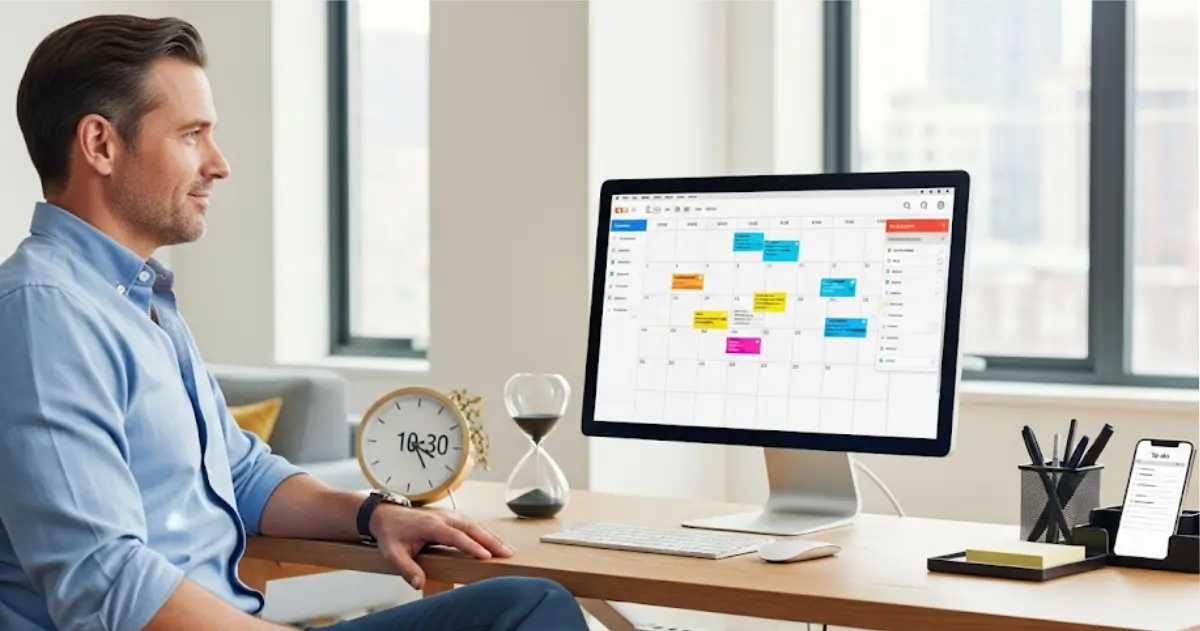
Planning is also essential for efficient time management. Organizing your day in advance—using to-do lists, digital calendars, or dedicated blocks of time—creates a solid framework that guides your actions. This practice prevents wasted time, reduces indecision, and makes it possible to focus energy on higher-value activities, rather than simply reacting to the circumstances of the moment.
Setting clear boundaries and deadlines is another key point. When a task doesn’t have a set deadline, it’s common for it to be put off or neglected. Working with deadlines creates a healthy sense of urgency and promotes concentration. In addition, learning to say “no” to commitments that don’t add value is essential for protecting the time set aside for priorities.
Eliminating distractions is also a key part of good time management. Frequent interruptions—such as cell phone notifications, social media, or even unproductive conversations—hinder focus and reduce the quality of work. Creating an environment that promotes concentration—with designated times to check messages and turn off unnecessary alerts—directly contributes to making better use of your time.
The use of organizational tools complements this process. Calendar apps, task managers, and even visual methods, such as Kanban, help structure appointments, track deadlines, and monitor results. By adopting these tools, time management becomes more practical and reliable, reducing oversights and increasing efficiency in task execution.
Another valuable principle is smart delegation. Often, trying to take on all responsibilities leads to overload and a loss of efficiency. Knowing how to delegate tasks to others, while making the most of each person’s skills, frees up time to focus on the most strategic and important tasks. Delegating does not mean giving up control, but rather utilizing teamwork in a balanced and productive way.
Although time management is linked to focus and productivity, it also requires planned breaks. Working without rest leads to burnout and a drop in performance. Short breaks, well-spaced throughout the day, allow the mind to recover so we can return to work with more energy and focus. Strategies such as the Pomodoro Technique show that short breaks can actually increase efficiency.
Another essential aspect is ongoing evaluation. Time management is a dynamic process that requires frequent adjustments. Reflecting on what is working, identifying areas for improvement, and implementing small changes ensures continuous progress. In this way, the time spent on activities becomes increasingly aligned with the desired goals.
Discipline and consistency are the foundation that underpins all other principles. Planning, prioritizing, and organizing only yield results when these habits are applied consistently. It is constant practice that creates a productive routine, reduces stress, and provides a greater sense of control over one’s life. Discipline transforms good intentions into concrete results, making time management truly effective.
Most Commonly Used Time Management Techniques
Eisenhower Matrix
It categorizes tasks by urgency and importance, helping you prioritize.
Pomodoro Technique
Work in 25-minute blocks with 5-minute breaks to stay focused.
The 2-Minute Rule
If something takes less than 2 minutes, do it right away.
Time blocking
Set aside specific times on the calendar for specific tasks to avoid getting sidetracked.
Digital Tools for Time Management
Digital tools have become valuable allies in time management, especially in an increasingly fast-paced world filled with simultaneous demands. They allow you to centralize information, create reminders, and track commitments in a practical way, helping to reduce forgetfulness and increase productivity. By using them, you can transform your daily routine into something more structured and efficient.
One of the main benefits is easy access to information. With calendar apps or digital planners, appointments and tasks are always at your fingertips—whether on your cell phone, computer, or other connected devices. This mobility ensures that you can stay organized anywhere, avoiding the need to rely on loose notes that can easily get lost.
Another important point is the ability to integrate different tools. Many time-management apps connect with one another, allowing emails, meetings, reminders, and tasks to be synchronized on a single platform. This centralization reduces the fragmentation of information and makes it easier to see the priorities for the day or week.
Customization also makes these tools very effective. They allow you to create categories, colors, and labels for different types of activities, such as work, studies, leisure, or personal commitments. This visual organization helps you quickly identify the areas that are receiving the most attention and those that need more balance, promoting a more mindful use of time.
In addition, digital tools help track medium- and long-term goals and projects. Features such as to-do lists, timelines, and progress charts make it possible to track each step until a goal is achieved. This ongoing monitoring boosts motivation and provides clarity on the progress made.
Another key benefit is the reduction of mental overload. Often, the accumulation of commitments in one’s memory causes stress and anxiety. By transferring this information to a reliable digital system, the mind is freer to focus on completing tasks, rather than constantly worrying about remembering what needs to be done.
Digital tools also promote collaboration and teamwork. Project management platforms allow multiple people to track deadlines, responsibilities, and ongoing tasks. This transparency improves communication among group members and helps keep everyone on the same page regarding priorities.
Another important aspect is the flexibility these tools offer. Adjustments can be made in real time, in response to changing priorities or unforeseen circumstances. Reorganizing a schedule or reassigning tasks takes just a few clicks, which makes it easy to adapt without compromising the plan.
Automatic notifications and reminders are practical features that help prevent delays and oversights. This functionality ensures that important appointments don’t slip through the cracks, even on busy days. When used in moderation, these alerts serve as a constant reminder to stay on track.
Using digital tools to manage time provides a greater sense of control over one’s life. With a clearer routine, people can reduce stress, better balance work and personal life, and make decisions with greater peace of mind. Thus, technology goes beyond being just a practical resource and becomes a true ally on the path to a more organized and productive life. The main tools for managing time are:
How to Link Time Management to Productivity
- Less multitasking, more focus: Studies by the American Psychological Association show that multitasking reduces productivity by up to 40 percent.
- Structured morning routines: High-performing professionals, such as the CEOs of Apple and Starbucks, start their day with consistent routines.
- Smart checklists: They help reduce errors and free up mental capacity.
Case Study
Profile: João, an IT manager at a multinational company. Problem: He was constantly overwhelmed, working more than 12 hours a day, and was unable to complete projects on time. Solution:
- He implemented time blocking in Google Calendar.
- He used the Eisenhower Matrix to prioritize tasks.
- He began delegating repetitive tasks. Result: He reduced his workload by 20% and increased the number of projects delivered on time by 35%.
Challenges in Time Management
Advanced strategies for those who have already mastered the basics
- Deep Work – a concept by Cal Newport that advocates for periods of absolute focus without digital distractions.
- Task batching – grouping similar activities to reduce transition time.
- Weekly Review – inspired by the GTD (Getting Things Done) method, which organizes appointments and goals on a weekly basis.
Time Management and Quality of Life
Good time management isn't just about getting more done; it's also about making room for what matters: rest, leisure, and family. According to a Gallup survey (2022), professionals who maintain a healthy work-life balance are 59% more likely to feel motivated and productive.
Time management is one of the cornerstones of productivity. When we learn to organize our routines strategically, we’re able not only to achieve more, but also to build a more balanced and fulfilling life. The secret isn’t in “having more hours,” but rather in making better use of the hours we already have.
See Also
Comments
Loading comments…
See also
 Time Management and Productivity | Vida Ideal Blog Shop
 Organizing Your Home and Office for Greater Productivity and Well-Being | Vida Ideal Blog Shop
 Productivity and Finances: How to Manage Your Time and Money to Live a Better Life | Vida Ideal Blog Shop
 Home Office Organization | Vida Ideal Blog Shop
 Personal Time Management | Vida Ideal Blog Shop