Sentimental Office Decor
Whether in a corporate setting or a home office, sentimental office decor has the power to influence mood, focus, creativity, and even self-esteem. When used effectively, it transforms the workplace into a more welcoming and inspiring environment. But how can this be achieved without creating visual distractions, visual clutter, or disorganization?
What is sentimental office decor?
Sentimental decorating is an approach that values objects with personal history, memories, and emotional significance. Unlike purely aesthetic decorating, it carries subjective values.
Examples:
- Photos of family, a mentor, or achievements
- An item inherited from a family member (watch, compass, notebook)
- Books that shaped professional development
- Art created by friends, children, or while traveling
According to interior designer Ana Vaz, “Emotional decor doesn’t have to be over the top—a well-chosen piece can say more about who you are than a shelf full of items with no emotional connection.”
Why bring memory into the workplace?
Bringing memories into the workspace is a powerful way to create an emotional connection with the environment. In a daily life that is often fast-paced and impersonal, objects that evoke fond memories, achievements, or loved ones help humanize the space, making it more welcoming and meaningful. This can transform the simple functionality of the space into a more personal and motivating experience.
Memorabilia, such as an old photograph, a souvenir from a trip, or a gift from someone special, serve as emotional anchors. They serve as constant reminders of our journey, values, and identity, which can be especially helpful during times of stress or creative blocks. Having something nearby that evokes positive emotions helps maintain balance and motivation.
In addition to the emotional aspect, bringing memories into the workspace also enhances authenticity. A personalized environment filled with objects that tell a story represents us more faithfully and uniquely. This can even have a positive impact on how we’re perceived by colleagues, clients, or partners in hybrid or in-person work settings.
Tangible mementos can also serve as sources of inspiration. A memorable book, a piece of art created by a friend, or a note saved from a special moment can trigger creative memories, spark ideas, and remind you of achievements that prove your own capabilities. This builds self-confidence and reinforces your sense of purpose.
Another advantage of sentimental office decor is the sense of continuity these elements provide. In times of frequent change—whether in job role, company, or work style—keeping objects with symbolic value helps establish a narrative that connects the past, present, and future. This is comforting and provides a sense of stability.
When working from home, bringing memories into your workspace is even more important. At home, the blurring of the lines between your personal and professional lives can be challenging, and objects that evoke special moments help make this space feel truly like your own. Work ceases to be an isolated obligation and becomes a more natural part of your life story.
However, it’s important to maintain balance in sentimental office decor. Too many objects can cause distractions or make it difficult to stay organized. The ideal approach is to select just a few items with real emotional value that can be incorporated harmoniously. This way, the space remains functional and aesthetically pleasing, without losing the symbolic meaning that gives it its identity.
Bringing memories into your workspace is an act of self-care. By surrounding yourself with positive memories, you strengthen your inner connections, reduce emotional strain, and cultivate an environment where it’s easier to feel good, work with joy, and maintain consistency. It’s a simple yet powerful way to align productivity with well-being.
A. Connection to Identity
An environment that reflects a person’s history enhances their sense of belonging and authenticity, which translates into emotional security at work. Keep this in mind when applying sentimental office decor.
B. Daily Inspiration
Having objects nearby that remind you of achievements, loved ones, or important moments helps boost your focus and resilience when facing challenging tasks.
C. Stress Reduction
Studies from Harvard Medical School show that environments with “emotional anchors” reduce cortisol levels by up to 20%.
How to incorporate meaningful objects functionally into sentimental office decor
A. Conscious Curation
Avoid cluttering the space. Choose 2 to 5 items that are deeply meaningful and can coexist without creating visual clutter.
B. Integration with the style of the space
Try to incorporate the objects into the office's color and material palette. For example: a subtle picture frame that matches the rest of the furniture.
C. Strategic positioning
Types of items that work well in sentimental office decor
A. Photographs
- In black and white or sepia for visual neutrality
- Preferably in thin frames
B. Natural elements with emotional value
- A rock brought back from a trip
- A small plant given by a loved one
- Piece of reclaimed wood
C. Art made by people close to you
- A painting made by a child
- Illustration by an artist friend
- Handwritten quotes
D. Symbolic transitional objects
- Pen used to sign an important contract
- Paper planner with valuable entries
- A watch inherited from a grandfather
Tips for Maintaining Visual Harmony
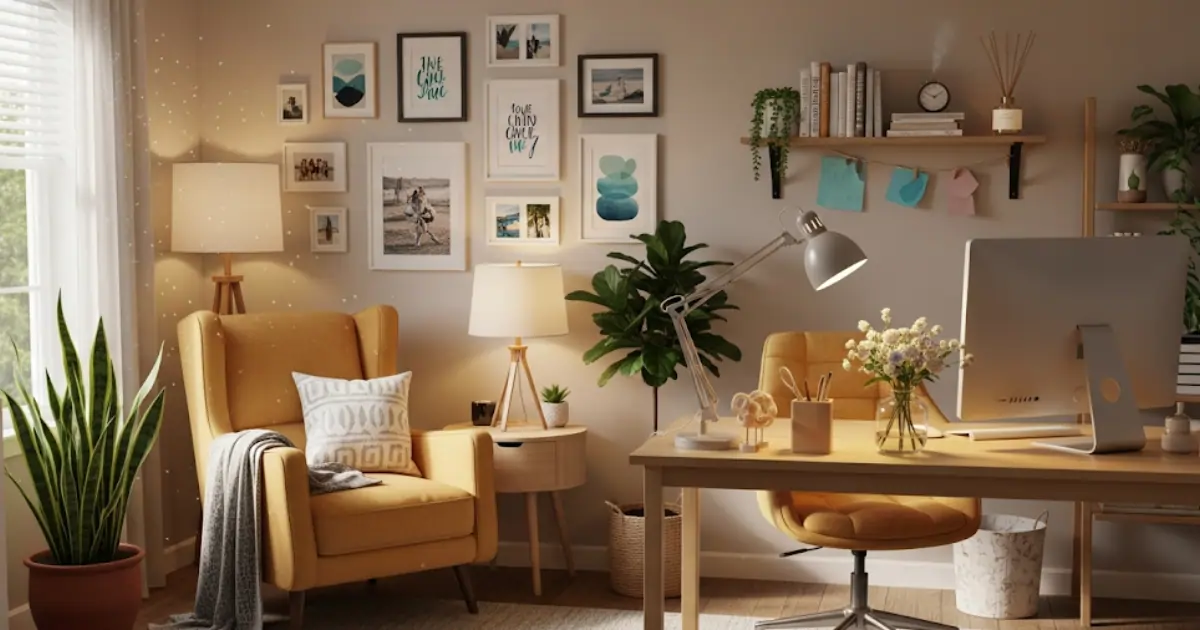
Maintaining the visual harmony of sentimental office decor is essential for creating a pleasant, organized work environment that is conducive to concentration. A visually balanced space conveys calm, reduces excessive stimuli, and promotes focus. Visual harmony does not mean rigidity or coldness, but rather aesthetic coherence and fluidity among the elements present.
One of the key tips for sentimental office decor is to establish a limited and consistent color palette. Neutral or soft tones serve as a base and can be combined with strategic pops of color to bring the space to life without going overboard. This chromatic consistency helps prevent eye strain and creates a sense of unity in the space.
Another important aspect is the choice of furniture and decorative objects. Choose pieces with shapes and finishes that complement each other, avoiding excessive mixing of styles. Minimalism is often a good ally in the quest for visual harmony, as it emphasizes the essentials and reduces visual clutter.
Organization is a fundamental pillar of sentimental office decor. Objects scattered around or out of place disrupt visual continuity and create a sense of discomfort. Using boxes, baskets, and organizers with a similar design helps keep everything in its proper place without compromising the overall aesthetic. An organized space naturally looks more attractive and balanced.
The proportion and balance among the elements of sentimental office decor also deserve attention. Distributing visual volume and weight symmetrically or in a balanced way prevents one area of the space from appearing more cluttered than another. This applies to shelves, wall art, lighting, and even the arrangement of furniture.
Lighting, incidentally, is another essential element. Well-distributed light, with the right color temperature and no harsh shadows, enhances the colors and textures of the space. In addition, light fixtures whose design complements the style of the space contribute to both practical function and aesthetics.
Textures should be used sparingly in sentimental office decor. Mixing wood, fabric, metal, and glass can visually enrich the space, as long as there is a common thread linking the materials. Repeating the same texture in different areas of the space helps create cohesion without becoming monotonous.
Remember to take a critical yet sensitive look at the office and its sentimental decor. Remove excess items, reposition objects, and experiment with different combinations. Often, small adjustments are enough to transform the atmosphere. Visual harmony is achieved more through intention than through perfection; it arises when everything seems to be in the right place, with purpose and balance.
A. A neutral palette as a base
Use white, beige, gray, or light wood as a base. That way, your cherished items will stand out without looking out of place.
B. The Rule of 3
Group sentimental items into sets of three: by theme (travel, family, achievements) or by shape (vertical, round, horizontal).
C. Organization Through Storytelling
Set up a shelf or display board that tells a story: from your professional development to your current journey.
Case Study: Luiz, an HR consultant, age 38
Setting
He works from home and found the office impersonal, even though it was functional. He was afraid of seeming “childish” if he included personal items.
Changes Applied
- A photo of his grandmother (who encouraged him to study) in a black frame on the bookshelf
- A pen from his first consulting firm, with his name engraved on it, placed above the keyboard
- Artwork by his son (a colorful elephant) in a frame above the monitor
- An old map of his hometown behind the door
Result
- He felt more at home there
- He began to feel “more whole” when he started his workday
- He received compliments from colleagues during a video conference about his son’s artwork
Things to keep in mind with sentimental office decor
A. Avoid using too many references
An office should have plenty of mental and visual space. Use up to 20% of the total decor for sentimental items.
B. Update from time to time
Change the photos, rearrange the objects. The idea is for the decor to tell your story—and your story is always changing.
C. Remain professional
Avoid items that might be considered controversial or too personal, especially in shared spaces or during virtual meetings where they are visible.
✅ Checklist: How to apply sentimental decor to your workspace
- I chose up to 5 items that have personal value to me
- I incorporated these objects into the room's color scheme
- I placed them strategically to inspire, without distracting
- I organized them into groups or used visual storytelling
- I curated the visuals and removed the excess
- I plan to review or update the decor every 3 months
- I feel represented and welcomed in my space
Sentimental office decor is an invitation to authenticity. In an increasingly impersonal and automated world, incorporating objects with symbolic value helps restore a sense of humanity to the workplace. With balance, curation, and purpose, it’s possible to have an office that’s elegant, organized, and truly your own.
See Also
Comments
Loading comments…